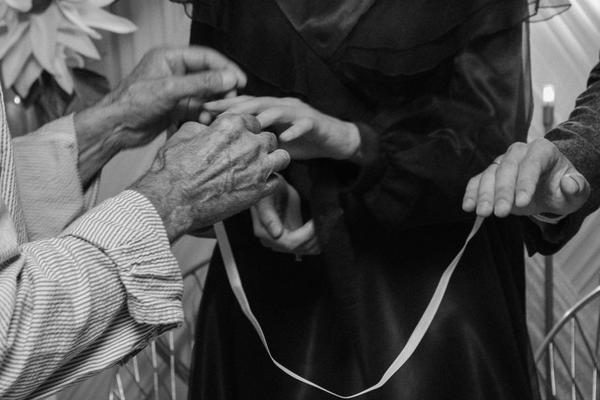
There is something quietly powerful about two people standing together while a cord is draped across their joined hands. A handfasting wedding ceremony makes a promise visible: two separate lives choosing to move forward as partners. It can feel intimate in a garden wedding or become a memorable focal point in a larger celebration.
The ritual is flexible, but that freedom raises practical questions. Who ties the cord? Should you speak your vows while your hands are bound? And how do you avoid an awkward tangle before the ring exchange? A little planning makes the moment feel natural.
What Does Handfasting Mean?
In a modern wedding, handfasting is a symbolic act in which a celebrant, friend or family member places a cord, ribbon or fabric around the couple’s joined hands. The material represents their chosen bond. Some couples finish with a visible knot; others let the cord rest across their hands while promises are spoken.
Handfasting is often described as a Celtic wedding ritual, especially associated with Scottish traditions. Historically, the term has referred to various kinds of betrothal and marriage agreement. Evidence for one identical ancient cord-tying ceremony is limited, so the familiar modern ribbon ritual is better understood as a contemporary interpretation, not an unchanged practice with a fixed script.
The tradition is popularly connected to the expression “tying the knot”, although that origin is not certain. Its meaning does not depend on a definitive historical explanation.
How a Handfasting Wedding Ceremony Works
A simple handfasting usually takes a few minutes: the couple joins hands, the celebrant introduces the ritual, a cord is placed around their hands, promises are spoken and the binding is released. The details depend on the wrapping method.
Step 1: Choose a Comfortable Hand Position
Couples may hold both hands or join one hand each. Holding both hands looks balanced in photographs, while a single-hand hold makes it easier to handle a microphone or vow card. Try both at the rehearsal.
Step 2: Place the Cord Loosely
The person leading the ritual lays the fabric across the joined hands and follows the agreed pattern. It must not restrict circulation or feel uncomfortable. Avoid tying tight knots directly around wrists: the moment is about connection, not restraint.
Step 3: Speak the Promises
The celebrant can explain what the cord represents, or the couple can recite personal handfasting vows. Keep the wording brief enough that everyone can remain comfortably still. Decide in advance who holds the microphone.
Step 4: Release the Binding
If you want to keep a knot afterwards, practise how the hands will separate while leaving the knot intact. Not every wrapping pattern creates a finished knot. Test the method with the actual cord before the wedding.
Choosing Handfasting Cords
Handfasting cords can be simple ribbons, braided strands, soft rope or strips of meaningful fabric. There is no universal requirement for a specific number of cords or particular colours. Choose materials that reflect your story and are comfortable to handle.
A family tartan can acknowledge Scottish heritage. Two contrasting ribbons might represent two individual lives, while one neutral cord keeps attention on the words. If using fabric from a treasured garment, make sure you are comfortable cutting or adapting it.
Test the length with your chosen wrapping pattern: fabric that looks generous when laid flat can become surprisingly short. Soft, flexible material behaves better than stiff trim. Check that edges will not catch on rings. For outdoor ceremonies, a slightly heavier woven cord is often easier to control than lightweight ribbon in the wind.
Where Does Handfasting Belong in the Ceremony?
The most natural placement is often immediately after personal vows or just before exchanging rings. The celebrant can introduce the cords as a reminder of promises already made. Alternatively, speak the vows during the binding so the words and gesture become one moment.
A possible sequence is welcome, reading, vows, handfasting, rings and closing words. That is a ceremony plan, not a legal template. Required declarations, paperwork and authorised officiants vary by location. Handfasting alone does not automatically create a legally recognised marriage.
For smoother transitions, draft a wedding ceremony order showing who moves, speaks or handles an object. Couples comparing unity ceremony ideas can also consider how to include children or family members.
Handfasting Wording and Vow Ideas
You do not need a long poetic reading. Effective wording explains the symbolism in language that sounds like you. For example, the celebrant could say:
“These cords do not hold you together by force. They mark the choice you make freely: to listen, to support one another and to keep finding your way back to each other.”
The celebrant might then ask, “Will you meet life’s changes with kindness, honesty and a willingness to grow together?” Each partner answers, “I will.” As the cord is placed, the celebrant adds, “May this knot remind you of promises renewed through everyday actions.”
Personal handfasting vows work best when they are specific. One partner might promise, “I will ask how you are really doing, celebrate the small victories and make room for us both to change.” The other can respond with different promises that feel equally genuine.
If you are writing personal wedding vows for the wider ceremony, avoid repeating them word for word during handfasting. Let your main vows tell your story and give the binding a short shared response.
Practical Details That Make a Difference
Imagine a couple exchanging rings immediately after handfasting. If both hands are still wrapped in fabric, the ring bearer may arrive before either person can reach for a ring. Rehearse a clear release point: the celebrant places the cord aside, then invites the ring bearer forward.
A relative can lay one ribbon across the couple’s hands, but limit how many people move into the ceremony space. Agree whether that person will speak or simply place the fabric. Keep the finished cord on a small tray or in a pouch so a meaningful keepsake is not forgotten afterwards.
Frequently Asked Questions
Is a handfasting ceremony legally binding?
Not by itself. Legal validity depends on the wider marriage ceremony and local law. Check requirements with your authorised officiant or registration authority; symbolic binding does not replace required declarations or documents.
How long does handfasting take?
A brief version may take around three to five minutes, depending on the vows, number of cords and participants. A rehearsal gives a more dependable estimate.
Do we need Celtic ancestry to include it?
No. Couples from different backgrounds appreciate its symbolism. You can acknowledge its Scottish and wider Celtic associations without claiming every modern detail is ancient.
Can a friend lead the handfasting?
Yes, a friend or relative can often lead the symbolic portion. That does not necessarily authorise them to solemnise a legal marriage, so coordinate with your officiant.
A Promise You Can See
The most memorable handfasting wedding ceremony is not necessarily the most elaborate. It is the one where the gesture fits your promises, the words feel genuine and everyone knows what happens next. Choose a comfortable cord, practise the release and give the moment room to mean something.