
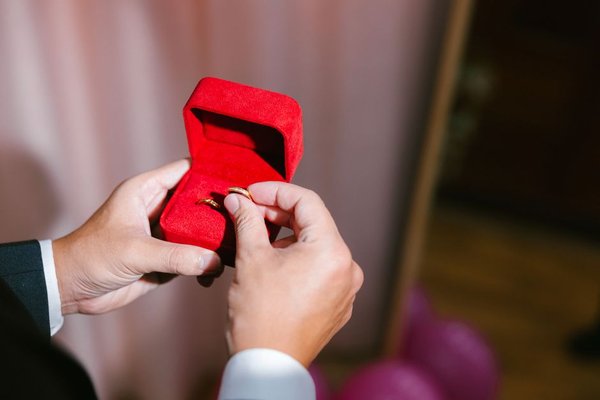
Choosing a wedding band works best when both rings are treated as one composition. Your engagement ring already establishes the main shape, metal, stone profile, and visual weight. The wedding band should support those features rather than compete with them. The two rings do not need to look identical; they simply need to fit comfortably and feel balanced on your hand.
Start With How the Two Rings Physically Fit
Before comparing metals or decorative details, check whether a wedding band can sit comfortably beside the engagement ring. The setting height and shape usually determine this. A high-set centre stone often leaves enough space underneath for a straight band to sit flush. A low basket, large halo, bezel, or wide decorative setting may extend outward and prevent a straight band from meeting the engagement ring closely.
If there is a visible gap, it is not automatically a problem. Some people prefer a little space because it lets each ring stand out. If you want a seamless stack, a curved wedding band or contoured band may be a better choice. These bands follow the outline of the engagement ring and can create a closer fit without forcing the rings against each other.
Match the Band Shape to the Engagement Ring
The outline of your engagement ring is a strong clue when choosing a band. A raised solitaire is usually versatile and can work with a straight, pavé, or decorative band. Halo and cluster rings need more care because the setting can interfere with a straight wedding band.
For elongated centre stones such as oval, pear, marquise, and emerald cuts, check how the stone sits in relation to the shank. If the head is raised, a straight band may still fit well. If part of the setting sits close to the finger, a contoured design can make the wedding band with engagement ring combination look more intentional.
A useful test is to view the rings together from above and from the side. The top view shows whether the outlines work visually, while the side view reveals pressure points, rubbing, or an awkward height difference.
Decide Whether the Metals Should Match
Matching metals create an easy sense of continuity. Platinum with platinum or yellow gold with yellow gold can resemble a matching bridal set even when the rings were purchased separately. Using the same metal can also help the rings develop a more similar surface appearance over time.
Mixed-metal stacks can also work when the contrast is deliberate. A white-metal engagement ring can look striking beside a slim yellow-gold band. If you mix metals, connect the rings through another feature such as stone detailing, width, or finish.
Balance Width and Visual Weight
Band width has a major effect on the overall stack. A very thin engagement-ring shank next to a much wider wedding band can make the engagement ring appear smaller, while two narrow bands create a more delicate look. If your engagement ring has a substantial setting or wide shank, a slightly wider wedding band may provide better visual balance.
As a simple ring stacking guide, judge the total width of both rings together rather than the wedding band by itself. Finger length, knuckle size, and comfort matter too. A stack that looks elegant in a close-up photograph may feel restrictive if too much of the finger is covered.
Coordinate Stones and Decorative Details
If your engagement ring has pavé diamonds or other accent stones, you can repeat that sparkle or use a plain band for contrast. Matching stone size and setting style creates a polished bridal-set effect. A plain metal band can instead frame a detailed engagement ring and keep the centre stone as the focus.
For vintage-inspired rings, repeating one detail such as milgrain, engraving, or a scalloped edge can make two different rings feel related. With minimalist engagement rings, a textured or lightly embellished band can add personality without overwhelming the stack.
Think About Everyday Wear
The rings may spend many hours touching each other, so practical compatibility matters. Raised stones, sharp edges, or exposed diamond girdles can rub against the neighbouring ring. Repeated contact may mark metal or wear small areas of a setting. A jeweller can check whether the rings make safe contact and whether a spacer would help.
Consider a low-set oval engagement ring with pavé shoulders. A straight diamond band may look perfect on its own yet sit too far away because the oval basket blocks it. A curved wedding band that follows the basket can close that gap, while a plain contour band may also reduce stone-on-stone contact. Trying the options together reveals more than judging each ring separately.
Should Your Wedding Band Match Exactly?
No. Exact matching is only one approach. Some people want the uniform appearance of a matching bridal set, while others prefer a stack that develops over time. A successful pairing usually shares at least one visual connection, such as metal colour, stone style, width, finish, or design period. From there, contrast can make the combination more personal.
Try the Rings Together Before Choosing
Whenever possible, try several bands with your actual engagement ring. Move your hand naturally and check for pinching, spinning, excessive gaps, or edges that catch. View the stack in ordinary daylight so you can judge the proportions realistically.
If ordering online, compare band widths and side-profile images. Knowing the engagement-ring setting height can help predict whether a straight band will sit flush. Measurements are especially useful with a curved band because its contour must correspond closely to the engagement-ring shape.
Frequently Asked Questions
Does a wedding band have to be the same metal as the engagement ring?
No. Matching metals create a cohesive look, but mixed metals can work beautifully when the contrast is intentional. Consider colour, durability, and how the two rings may wear where they touch.
What wedding band works best with a low-set engagement ring?
A low-set ring may block a straight band from sitting flush. A curved, contoured, or open wedding band can provide a closer fit, depending on the shape and width of the engagement-ring setting.
Is a gap between the engagement ring and wedding band okay?
Yes. A small gap is a style choice and does not mean the rings are mismatched. Some wearers like the separation because it lets each ring remain visually distinct.
Should the wedding band be wider or thinner than the engagement ring?
Either can work. Aim for proportions that feel balanced on your hand. A delicate engagement ring often suits a slim band, while a more substantial ring may pair well with a band of similar visual weight.
Creating a Pair That Feels Deliberate
Learning how to match wedding band to engagement ring comes down to combining fit, proportion, and personal style. Start with the physical relationship between the rings, especially setting height and shape. Then compare metal, width, stones, and decorative details. The best pairing is not necessarily the one that matches most closely; it is the one that looks considered, feels comfortable, and can handle everyday wear. When those qualities align, the rings read naturally as a set while still reflecting your individual taste.